Home / What's On / Apurva: Ranjani-Gayatri and Purbayan Chatterjee 2026 in Dubai
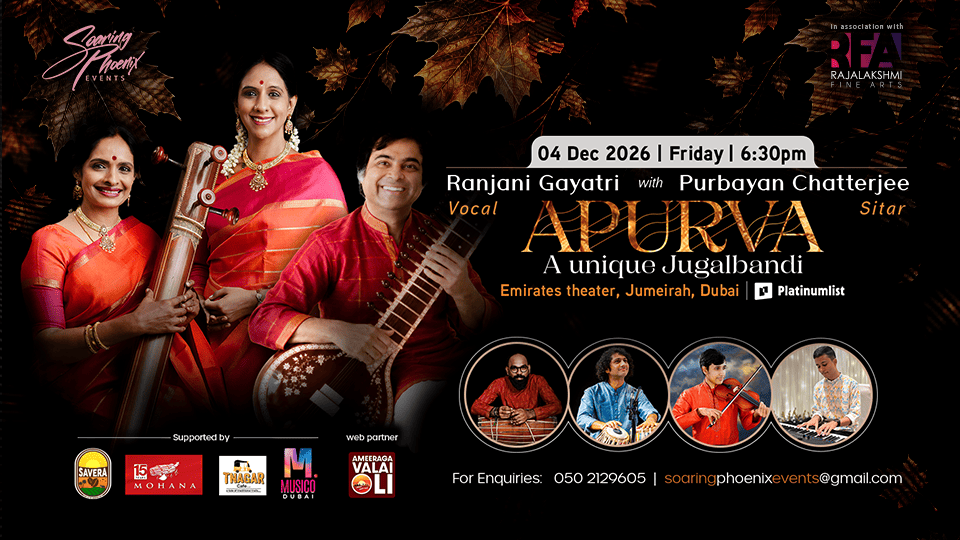
Apurva: Ranjani-Gayatri and Purbayan Chatterjee 2026 in Dubai
- Friday 4 December 20266:00 pm – 10:00 pm
- Emirates TheatreEmirates International School - Jumeirah - Al Thanya St - Dubai - United Arab Emirates Dubai,DubaiUnited Arab EmiratesOpen in Maps →
- AED 100Tickets
Apurva: Ranjani-Gayatri and Purbayan Chatterjee 2026 in Dubai is an evening of Indian classical music at the Emirates Theatre, Emirates International School in Jumeirah, on Friday 4 December. It is built around a jugalbandi, a musical conversation between artists from different traditions: the Carnatic vocal duo Ranjani-Gayatri from the south Indian tradition, and the sitar player Purbayan Chatterjee from the Hindustani tradition of the north. The organisers say it is the first time this particular pairing has been staged in Dubai.
The concert is presented by Soaring Phoenix Events in association with Rajalakshmi Fine Arts. Doors open at 6pm and the music starts at 6:30pm.
What a jugalbandi is, and why this one is unusual
Carnatic and Hindustani music share roots but developed separately, with their own ragas, ornamentation, rhythmic systems and concert customs. In a jugalbandi, musicians trade phrases, answer one another and build improvisations together, so the result is never quite the same twice. Many jugalbandis pair two instruments. Apurva instead sets two voices against a sitar, with the singers’ Carnatic phrasing meeting Chatterjee’s Hindustani melodic approach on the same stage.
The name Apurva is a Sanskrit word often used to mean something rare or unprecedented, which fits the organisers’ framing of the evening as a first for the city.
Ranjani-Gayatri
Ranjani and Gayatri are sisters who grew up in Mumbai and started out as violinists before their teens, training under T.S. Krishnaswami at the Shanmukhananda Sangeet Vidyalaya. In 1997 they began giving vocal concerts after becoming students of the Padma Bhushan vocalist P.S. Narayanaswamy, and they have been one of Carnatic music’s most visible duos ever since, appearing regularly at Chennai’s December music season. Earlier in their careers, as violinists, they performed with greats such as D.K. Pattammal and M. Balamurali Krishna, and their first vocal album, The Awakening, came out in 2000.
They are especially known for abhangs, Marathi devotional songs that they often set to music themselves and sing towards the end of a concert, including Tukaram’s Bolava Vitthala. They sing in Sanskrit, Tamil, Telugu, Kannada, Malayalam, Hindi, Marathi and Gujarati. Their honours include the Padma Shri in 2026, the Music Academy’s Indira Sivasailam Endowment Medal and the Sangeeta Kala Siromani title. The Platinumlist listing features their recording of the Sri Rama Raksha Stotram.
Purbayan Chatterjee
Purbayan Chatterjee, born in Kolkata in 1976 and now based in Mumbai, learned the sitar from his father, Parthapratim Chatterjee, and his style draws on the playing of Pandit Nikhil Banerjee. He won the Rashtrapati Award, the President’s award for the best instrumentalist in India, at the age of 15.
Alongside his classical work he has long moved between genres. He founded Shastriya Syndicate, described as India’s first Indian classical band with a contemporary sound, and his album Stringstruck won the Palm IRAA award for Best World Music Album. He has worked with Shankar Mahadevan, Ustad Zakir Hussain, Rakesh Chaurasia, Kala Ramnath and Shashank, and designed the Dwo, a sitar-like instrument of his own. His discography runs from Horizon in 1999 through the bestselling Lehar in 2008 to Saath Saath, a 2022 album with flautist Rakesh Chaurasia, and in 2013 he composed an anthem for his home city of Kolkata. That experience of crossing boundaries is exactly what a Carnatic and Hindustani meeting needs. The listing also features his instrumental Hum Bewafa Hargiz Na Thay (Unwind).
The ensemble on stage
Four accompanists complete the line-up, and their instruments show how the two traditions are being combined:
- Vittal Rangan on violin, the core accompanying instrument of a Carnatic concert.
- Sai Giridhar on mridangam, the double-headed drum of south Indian music.
- Ojas Adhiya on tabla, the Hindustani percussion pairing.
- Hemant Gadkari on keyboard.
Having both mridangam and tabla on stage is a clear sign of the jugalbandi format: each tradition keeps its own rhythmic voice, and some of the most exciting passages in these concerts come when the two percussionists trade patterns.
The venue and getting there
The Emirates Theatre sits within Emirates International School on Al Thanya Street in Jumeirah. By car, head along Sheikh Mohammed bin Rashid Boulevard, continue onto Al Safa Street and then turn right onto Al Thanya Street, where the school is on the right. Taxis are an easy alternative, as most drivers know the venue. The listing gives no parking details, and no age policy or dress code is stated. If you cannot make it, the ticket page says tickets can be exchanged with another fan.
This concert will appeal to Carnatic rasikas who know Ranjani-Gayatri from the Chennai season, Hindustani listeners who follow Chatterjee’s sitar, and families who enjoy classical music together. It is also a good introduction for anyone curious about how the two Indian classical traditions meet.
For more evenings like this, see our concerts in Dubai and art and culture guides, or browse things to do this weekend and December in the UAE.
Frequently asked questions
What time does Apurva start at the Emirates Theatre in Dubai?
Apurva starts at 6:30pm on Friday 4 December 2026, with doors opening at 6pm. The listing does not give a finish time, though its calendar entry runs to 10pm. The concert is at the Emirates Theatre inside Emirates International School, Jumeirah.
Who is performing at Apurva in Dubai?
Carnatic vocal duo Ranjani-Gayatri and Hindustani sitar player Purbayan Chatterjee lead the concert. They are accompanied by Vittal Rangan on violin, Sai Giridhar on mridangam, Ojas Adhiya on tabla and Hemant Gadkari on keyboard.
What is a Carnatic and Hindustani jugalbandi?
A jugalbandi is a musical dialogue where artists trade and answer phrases, often improvising together. At Apurva, the south Indian Carnatic tradition, represented by Ranjani-Gayatri's voices, meets the north Indian Hindustani tradition through Purbayan Chatterjee's sitar, with both mridangam and tabla on stage.
Is this the first time Ranjani-Gayatri and Purbayan Chatterjee have performed together in Dubai?
Yes, the organisers, Soaring Phoenix Events with Rajalakshmi Fine Arts, describe Apurva as the first time this jugalbandi has been hosted in Dubai. It is one evening only, on Friday 4 December 2026 at the Emirates Theatre.
Where is the Emirates Theatre in Dubai?
The Emirates Theatre is inside Emirates International School on Al Thanya Street in Jumeirah. By car, follow Sheikh Mohammed bin Rashid Boulevard onto Al Safa Street, then turn right onto Al Thanya Street, with the school on the right. Most taxi drivers know the venue.
Is there an age limit or dress code for Apurva in Dubai?
No age policy or dress code is stated on the ticket page for Apurva. If you plan to bring young children, it is worth checking with the organisers, Soaring Phoenix Events, before booking, as the listing gives no guidance either way.
You might also like
Hosting an event in the UAE?
List it for free and reach people planning their week across the Emirates.